Showing posts with label museum. Show all posts

Not Quite a Magic School Bus Episode


(I’d like to apologize for not finishing this and posting it in a timely manner- I was kinda feelin’ like a butthole with a fever. Butt I got better! I am now a firm believer that butt tons of sleep, not-productiveness, television, and good music and dancing are all keys to feeling better. Especially the good music and dancing part.)

Howdy y’all.  I got back from a four-day field trip to the north of Thailand and the Golden Triangle.  Basically, this field trip was a blur of long van rides and visiting random places that pertain to what we’ve been learning in class: the opium trade, international relations, ethnic hill tribes within Thailand, and the sex industry.

I won’t do a stop-by-stop description of our itinerary, mostly because I don’t remember the order, or the location of all of our stops, but also because I’m quite tired of talking about myself.  I will, however, give an overview of what I’ve been learning in tandem with some pertinent pictures of the trip.  Get ready to be educated.

Sorry for the diction and lack of exclamation points: I’m brain dead from attempting to write one of two long papers.  I love the research aspect, hate the actual writing.  Poop.

SO! Let us begin with the sex industry to continue with the theme of the last post.  We visited the main base for The Sold Project, an NGO that works toward keeping kids in school by granting scholarships and giving them a recreation area to be tutored and play.  By keeping them occupied with school and granting scholarships, this helps to keep the kids from being sold to the streets as unskilled laborers or sex workers.  The families no longer have to worry about balancing the burden of paying for their child’s education (the education is free, but things like uniforms, school supplies and transportation become financial issues).  This NGO has about 20 additional bases all around Thailand, and they are looking to expand.  The staff and volunteers tutor the children, make visits to make sure life at home is acceptable, judge annual scholarship applications, campaign for financial donations, and teach community members skills such as silk-weaving using the silk grown by silk worms in the backyard.  This NGO was started only a few years ago with a dream of an American doctorate who gained some motivation from an inspirational book, combined with the gratitude of a pair of Chiang Rai twins who were given educational support by a very nice benefactor.  It’s amazing what a bit of positive action can accomplish.  Basically, this little visit made me realize two things: I’m really awkward around children, and that anyone can change the world with a bit of oompf.


Another place of interest was the Hill Tribe Museum. Let me give you some background about hill tribes.  A lot of the countries in Southeast Asia are made up several types of people.  This is because the Western concept of territorial boundaries was forced upon the people of Southeast Asia by Western colonial powers way back when that was happening.  So, there are a lot of problems with ethnic discrimination, loss or falsification of ethnic identity, and statelessness.  Example time:

1)      Ethnic discrimination: one of my friends here in Thailand is ethnically Shan (one of many ethnic hill tribes in Thailand; there’s also the Hmong, Mon, Lisu, Karen, Lahu, and the Aka just to name a few more), but he goes by a Thai name and hides his ethnicity in order to escape discrimination.

2)      Falsification of ethnic identity: tourists want a show.  So, to heed the wishes of their money-ridden visitors, cultural acts are put on.  The Karen people wear golden rings around their necks, much like that one tribe in Africa, but this is not a traditional practice of the Karen.  It’s a fraud!

3)      Statelessness:  The Rohingya people are a group of people from the Arakan state.  They are not given citizenship in Burma, even though many of them live there.  Instead, they are persecuted, often given shitty jobs, and they are trafficked between Thailand and Burma.  The authorities of both countries are guilty of supporting this practice, ruining the lives of these people who are denied the right to a state.  Many live across the border in Mae Sot, a refuge city in Thailand, right across the border to Burma.

End Verdict: these ethnic peoples have some problems.  Now you are aware if you were not before.  Speaking of problems, this whole conflict between Israel and Palestine is getting REALLY OLD! If we could fast forward ten years into the future, and this is still going on, I swear I will attempt to join efforts to resolve this ridiculous issue.

Anyway, back to the museum.  The museum is run by an NGO that aims to help hill tribe peoples, promote the usage of condoms to prevent the spread of diseases, provides family planning services, and supports organic farming.  The museum is one way of internally raising money for the organization, the other is a restaurant called Cabbages and Condoms.  Unfortunately, we did not get to eat here. L


(I wrote all of this two days ago and do not feel like writing much more on a depressing albeit informative topic.  Also, the field trip was lackluster in terms of excitement.  A bunch of temples, old and new, and some more museums.  Thoughts on the latter shall ensue.)

We visited the ‘museum’ (the term is used loosely because barely anyone visits the museum and it has a crap ton of cobwebs everywhere) for Khun Sa, who was the Opium Prince.  Basically, he was the voice of the Shan people, who were promised their own state, separate from Burma, after a ten-year period after gaining their independence.  This was organized by Aung San Suu Kyi’s daddy, but then the new regime under General Nu Win went and assassinated him and for some reason this makes that agreement null. That pretty much fueled the ambitions of the Shan people.

Khun Sa raised an army in the hills, and created a grand empire based upon the growth and sale of opium.  He basically became a millionaire on this whole trade and was able to create an army that aided his business transactions. Obvs, a great drug lord.  His reasoning for all this was that an army needs money, and money can be made with drugs.  He wanted to money for the creation of the new Shan state. The Shan don’t have their state, and Khun Sa is dead. History in a very crappy nutshell.

We went to the Golden Triangle, where Thailand, Myanmar, and Cambodia meet. Lots of trade, drugging, and gambling happen here.  My professor used the made up word “casinofication” to describe what’s going on here (I swear, he adds “ification” and “ization” to EVERY word he possibly can”).   If ya wanna gamble, do it there.  But I don’t condone it because all of this crappy development is harming the environment and the cultural richness of the area.  Migration patterns of the famous large catfish through the Mekong are being destroyed, and an entirely new material, cultural mindset is settling in over the people.


We then visited the Opium Museum.  It was the best museum that I’ve seen in Thailand- I’ve realized that lighting really makes for a good museum.  There were also short video clips, and creepy ass wax people. We weren’t allowed to take pictures, and I was also too freaked out to take a picture of this anyway, but here’s a short story: whilst watching a video about how drugs affect your brain, my professor said “hey Jessica, turn around and look at this!” he pointed at the ground and as soon as I looked, the floor lit up, and I saw people inside of a jail.  Oh my dear lord. It was the most awful thing ever.  I had not noticed it upon my entrance into the room, but the entire floor was glass, and underneath were two jail cells holding two wax figurines of drug addicts.  What the heck, museum. These wax things were everywhere.  Other than that, it was an excellent museum, especially if you wish to know every detail about the Opium Wars.

So, overall, the field trip was excellent! The best part though, was waking up at 5:30 am to walk up an infinite amount of stairs to watch the sunrise with some of my friends here.  It was beautiful, and it was lovely to see the valley slowly come to life.  Even walking in the dark before dawn, the streets were alive with people setting up their produce to sell later that day.  At the top of the stair mountain, at the temple, we heard a great chorus of roosters waking everyone up, and then, after the sun rose, there was obnoxious music.  It was amazing.  I highly suggest waking up to watch a good sunrise.  I promise, it sets a wonderful tone for the rest of the day.  And on that note, I end zis post.


Just kidding. Watch this, it's worth it : http://www.youtube.com/watch?v=B9tNGEt6rmE. Now, errbody, go out there and dance like the party animals I know you all are. I'll be right there with you, pulling these moves out.

Slightly Hanoi'd


This title was my own creation, and has nothing to do with the Good Morning, Vietnam soundtrack that I am still listening to.

So! My adventures in Ho Chi Minh City ended with a slight mishap in determining which terminal I belonged in.  And the beginning of my adventures in Hanoi began with a silent taxi ride (my driver didn’t speak much English and seemed to enjoy the silence) through the night.  The hostile I booked in Hanoi, Central Backpackers Hostel, does airport pickup service, so for the first time I got to feel like one of those special people who have to look for their names on a piece of paper.
See how far away Hanoi is from Ho Chi Minh City!
 

My first impression of Hanoi…well, by this point, I was tired of the city because I usually dislike cities anyway.  To make matters worse, Hanoi is much busier and crowded than Ho Chi Minh.  I stayed in the Old District where there is a lack of tall architecture, the streets are narrower, and there is no end to the amount of clothing and shoe shops in sight.  Hanoi is incredibly busy, and has some of the craziest traffic I’ve ever seen.  During my stay in Hanoi, one of my friends, Elias, walked out in front of a car so that we could cross a sea of traffic that never stops.

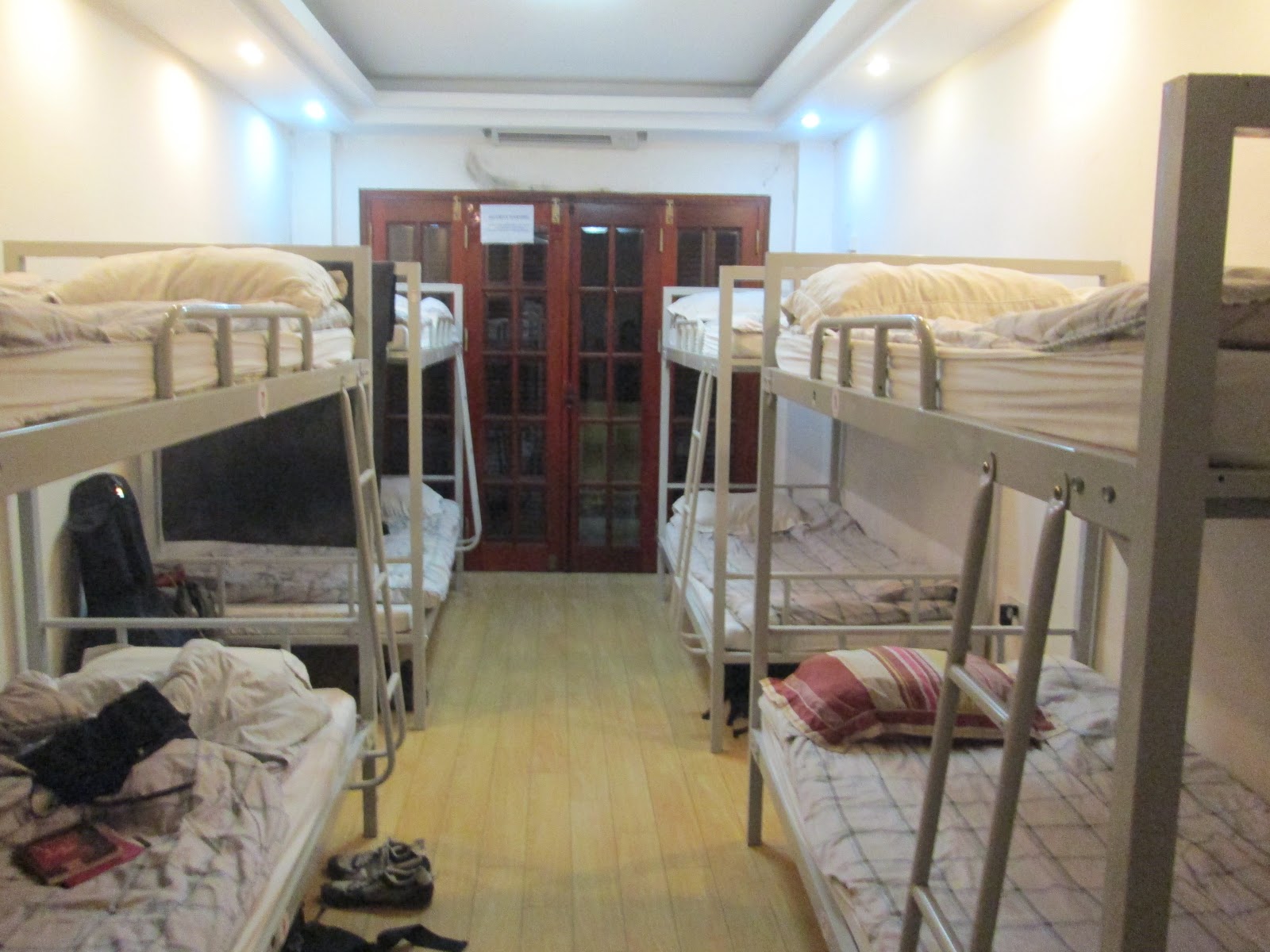
So, Central Backpackers Hostel is amazing.  It’s cheap, has awesome people, free bia hoi (the fresh brew that costs 4000 dong, approximately 5 cents) from 7-8 pm, free breakfast (consists of banana, bread, jelly, butter, and tea or coffee), provides lots of different kinds of trips.  The best part was the people I met there. More on that throughout this post.
This dorm was super great and full of bed friends!

First order= dinner.  After free beer hour, I went to dinner with my newfound friend and dormmate, Elias from France.  We ate at Quan An Ngon Restaurant.  It was okay- too pricey for so little, but this is working in the mindset of a poor college student/traveler and a backpacker.  Make sure you ask about the sizes of the dishes because what you would think would be a served in a large proportion, could be the size of your fist.  The restaurant is cool though- it has the same community as street food on the sidewalk with a classy flavor and decor, distance from the traffic, and way more options.
Lotus seed "dessert". Way too sweet, but yummers
 

That night, I just took it easy talking to different backpackers at the hostel.  Beyond where people have travelled, it’s amazing to get a glimpse into what occupations they left behind, some of their hobbies, what their friends are like, etc.  Everyone is so different, yet everyone is tied in this cycle of wanting to experience the world and going on pretty much the same route to do it.  In terms of future travel, I also discovered through these people social networking websites geared towards helping backpackers such as Couch Surfing and Be Welcome.

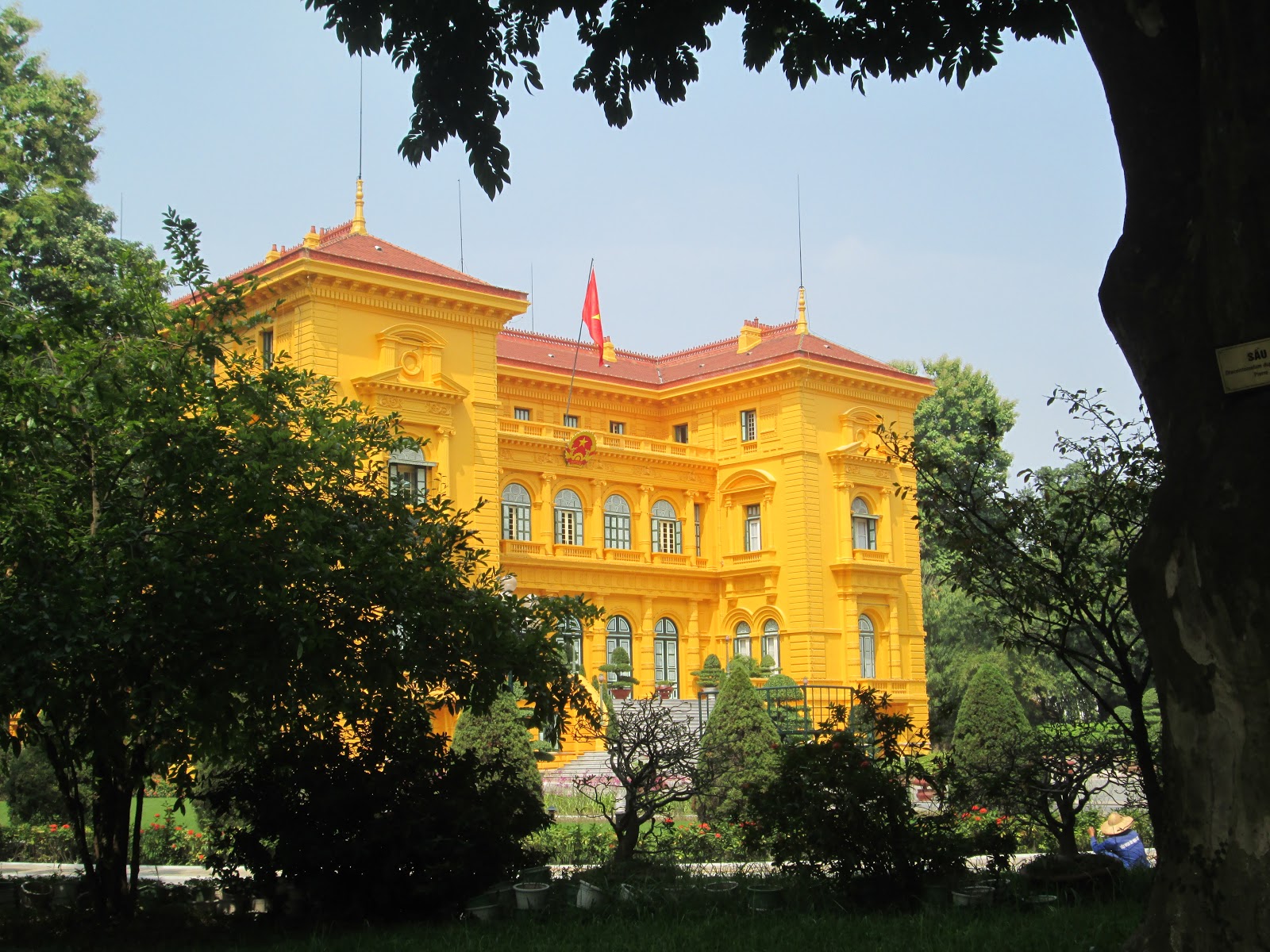
Next day, I made Elias my exploration companion to explore the west end of the district.  We passed the large statue of Vladimir Lenin, the Ho Chi Minh Mausoleum, the Presidential Palace, and the One-Pillar Pagoda.  The sights were rather boring, and we didn’t spend long in any location.  The palace should have been more exciting, but it was basically a bunch of sparsely decorated rooms and old cars that you viewed through glass.
Ze mausoleum, where I got yelled at for stepping over the yellow line

Presidential Palace, the most obnoxiously yellow building in Hanoi
 

I went to the Temple of Literature, where Confucius taught a bunch of students, afterwards.  It was an interesting mixture of modern topiaries and old buildings.  I find Chinese architecture and idols really beautiful and interesting, but I was so tired of looking at religious art, statues, and buildings, that I felt pooped.  Despite this feeling, I definitely like the temple a lot.
Turtle stelae at the temple

That night, Maia arrived in Hanoi, but she was exhausted from her journey in Luang Prabang in Laos, so I went out with some people at the hostel. During free beer hour, I sat with some people that I knew, and met some more people.  After a few beers, a group of us went to get dinner two shops away, and thus the party group was formed.  We ended up at a dance club where I discovered that I am an amazing dancer according to the reactions of the surrounding folk.  Here’s some advice for you other young ladies who love to dance: in Hanoi, there are plenty of gross foreign older men who like to try to watch young ladies dance and try to dance with them or more.  So, if you can’t take it, don’t shake it.
My dance partners
 

Next day, I spent the day exploring the area around Hoan Kiem Lake with Maia. Most of it was just walking around and getting a feel for the city, which I won’t explain, but here’s a quick and dirty list of what we did.

1)      The Hoa Loa Prison where the French displaced a village to build their own institutions.  Many Vietnamese prisoners were tortured here, and later, American soldiers were held captive.  This was a very depressing place, and the creepy factor was heightened by the sounds of fearful music.  My only problem with the museum was the Communist propaganda.  While John McCain says that he was tortured in this prison, the museum posts descriptions of the Vietnamese treating the Americans as best they could.  They were provided with basic comforts, were allowed to play basketball, and colored pictures for Christmas.  I find this hard to believe, but whatever.  If anyone has anything to say in support of the museum’s statements, please tell me.

The scariest room in the building

2)      The shrine on Hoan Kiem Lake.  This was a cute little place with the largest imitation of a turtle I’ve ever seen, and the tiniest bathroom stalls.  I’m a rather small person, yet my face was an inch away from the door- I would not call that one a happy room. I urge everyone to click on the above link to read the legend about the Restored Sword; this is how the lake got its name, and it was the inspiration for one of the plots that I watched at the water puppet theatre show.

3)      TrangTien ice cream parlor.  Soft serve ice cream for 10,000 dong (50 cents)? Heck yes! It was “so damn hot I saw one them little men in those orange robes burst into flames” (Adrian Cronauer- I didn’t really see that), so the ice cream was a welcome treat.

4)      St.Joseph Cathedral.  It’s really pretty, but we didn’t get to go inside.
It is grey and magnificent
 

5)      Lotteria for a water and air conditioning break.  Lotteria is a fast food chain in Vietnam.

6)      We bought water puppet tickets to see a show later that night (it’s necessary to buy your tickets earlier in the day so that you can see the show at the time you want), but we ended up not going because we were so exhausted by the end of the day that the thought walking through the overwhelmingly crowded streets any more was about as appealing as juggling my brother’s smelly athletic shoes.

7)      We walked through the large Night Market along the streets of Hang Ngang and Hang Dao. It’s like Walking Market in Thailand, but with copious amounts of traffic and crowding within the stalls.  At the end of the street is the Dong Xuan Market.  I was so overwhelmed by the crowds that I didn’t have the energy or desire to look inside.  Besides, not all the shops were open by this point, and I hate shopping.
This picture doesn't even capture the busy-ness of this street.

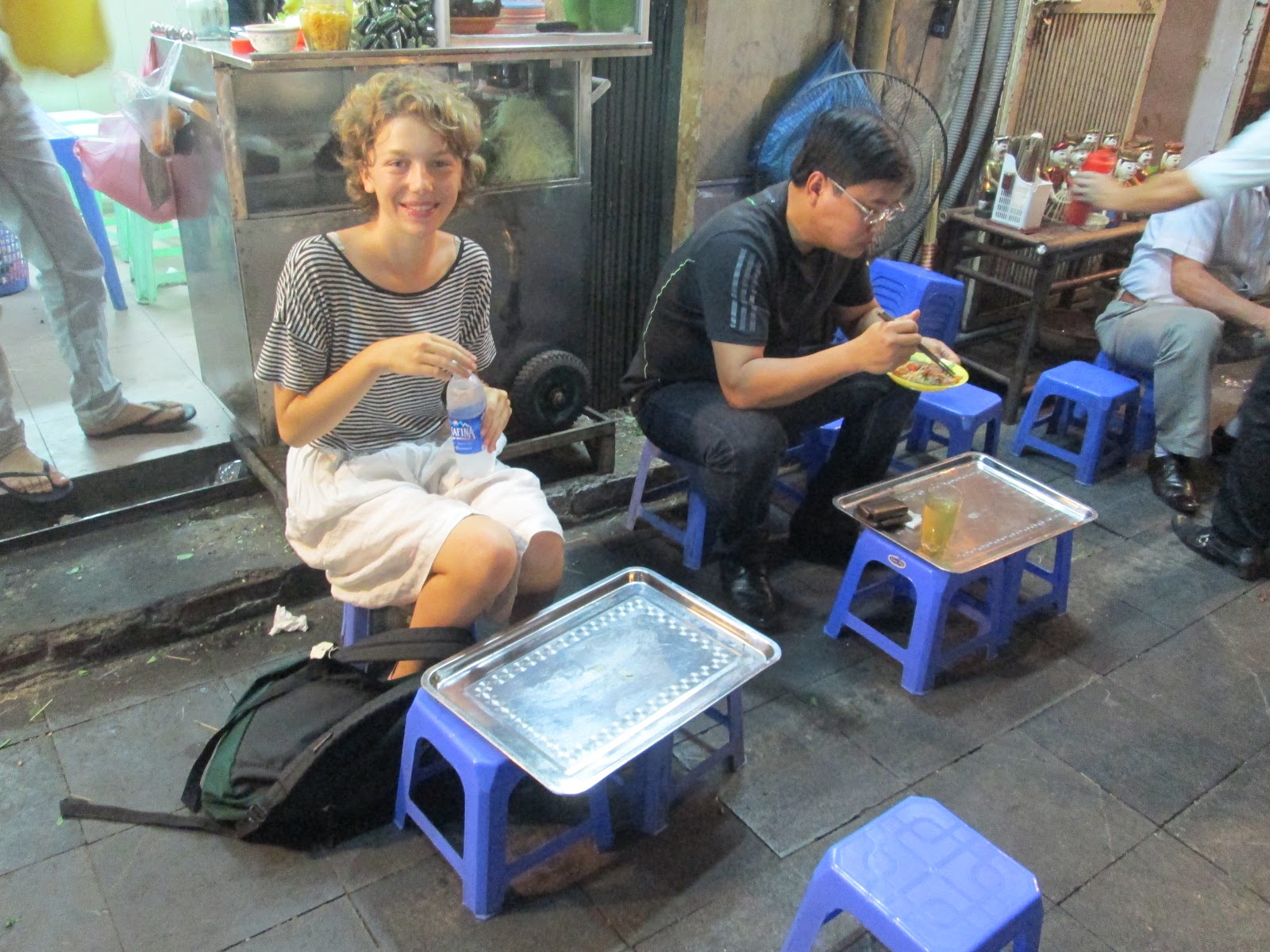
8)      We ate street food and experienced the tiny chair culture.  It was awesome, and the food that we ate on the street was my favorite meal that I’d had in Hanoi.  I’m not sure what it was- I think it was green papaya salad with beef, peanuts, and herbs dumped in some sweet juice.  It seems to be similar to Bun bo Nam Bo, but it could be Nom Du Du.  (Other recipe- Pho Bo, another food to try- there are sandwich kebab vendors everywhere and oh my god they are so tasty)

Table for two!

I'm really hungry right now.  For real.  I can't wait until my Mexican food gets here.
 

So that pretty much concludes my adventures in Hanoi! Hanoi is a very crowded city, and I didn’t do a lot of the things that one could do there. The city offers a bunch of different museums for people depending on one’s interests (Fine Arts Museum, Museum of Ethnology, Vietnamese History, Women’s Museum, etc.), trips to Sapa, etc. The buildings are amazing because you can see a wide variety of buildings within one block- Chinese architecture, French architecture, modern buildings, run-down buildings, fancy and clean buildings, and more…all stuck together in a weird combination.  It’s quite fascinating.  Hanoi was okay, but I was ready for HALONG BAY!

Admire the diversity.